
Is there such a thing as MAD in economic warfare? How should we measure the effectiveness of our industrial policy tools, and what outcomes should we be aiming for anyway?
Our guest today is Dan Kim, who served at USITC with stints at Qualcomm and SK hynix before returning to government as the Chief Economist for the CHIPS Program Office. He recently joined TechInsights as Chief Strategy Officer. Also joining us is Chris Miller of Chip War fame.
We discuss:
What $39 billion can and can’t buy — why the CHIPS Act was never meant to de-risk the U.S. from China or Taiwan, and what “success” looks like when autarky is neither affordable nor desirable,
Apple vs. Xiaomi + BYD — invention versus fast-following as competing models of national power, and which system performs better when the goal shifts from profit maximization to geopolitical resilience,
What resilience actually means — capability vs. capacity, weakest links, and whether economic security should be measured as “time to recovery” rather than self-sufficiency,
Managed dependence vs. overreliance, and whether dependence itself can be a form of power,
Why the U.S. still lacks a clear theory, metrics, and institutional design for industrial strategy — and what you can do about it.
Listen now on your favorite podcast app.
Getting Punched in the Mouth
Jordan Schneider: When you got the mandate to help conceptualize what the CHIPS Program Office should spend money on, what was your thought process? Where did you begin?
Dan Kim: Secretary Raimondo asked me to come in, and we had a chat about how to draft up a strategy from a blank piece of paper and execute it. We had congressional mandates — specifically spending at least $2 billion on mature node technologies — but few prescriptions for what success looked like or how to measure it.
Remember, this was in the middle of COVID-induced supply chain shortages. There were parking lots full of unfinished cars near Detroit. Some executives told me there were unfinished Carnival cruise ships — billion-dollar ships that couldn’t be finished because of $2,000 worth of accessory chips. When I was meeting with the Secretary while representing a company, the question was: how soon can you get another fab online? There wasn’t a recognition of a memory shortage at the time — it was mostly shortages of less advanced chips, like MCUs, that couldn’t finish a car. We needed to get a better handle on supply chains and ensure a steady supply. And remember, at the time we couldn’t make masks either — PPE, etc. That was the tenor.
Simultaneously, ChatGPT launched. I recognized immediately that if we executed CHIPS during a demand-driven upcycle, we would hit a down cycle — a supply glut, not a shortage — mid-execution, right as we’re trying to build more supply. So we needed a nuanced view of success.
My first assignment was the Vision for Success paper. We told the world what we were aiming for — at least two competitive clusters of leading-edge logic manufacturing, mature node capacity, advanced packaging, and specialized technologies like compound semiconductors.
Some interpreted it as us asking for everything, but we were careful to couch the language to carefully communicate what we were aiming for to Congress and potential applicants. And we were aiming for a lot.
The paper I initially wanted to write wasn’t about what we’re hoping to achieve, but rather a diagnosis of how we got here in the first place — to describe the disease we’re trying to cure rather than what a healthy patient looks like. Chris, you would have enjoyed writing that because it’s a historical view — if we’re at 10% of semiconductor manufacturing capacity now but started with 100% when we invented the thing and about 40% in the 1990s, how did we get here?
I initially wanted to write a diagnosis of the problem rather than a vision of health. How did we go from 100% of semiconductor manufacturing capacity to 10%? How did the U.S. miss the foundry model? How had we effectively outsourced all of memory production, and was that a bad thing and to what degree? We scrubbed that draft to focus on forward-looking targets, but understanding that history was crucial to defining the disease we were trying to cure.
Mike Schmidt, quoting Mike Tyson, liked to say, “Everyone has a plan until they get punched in the mouth.” We got punched about 500 times by 500 potential applications. We were oversubscribed and lacked prior government experience in this area. Looking back, it turned out well, but to prioritize we had to answer fundamental questions along the way like — How do you define economic and national security? How do you measure it? We didn’t have infinite dollars.
Chris Miller: Let’s go deeper on prioritization. You mentioned the Vision for Success paper included two leading-edge logic clusters, memory, and foundational semiconductors. What almost made it but didn’t have the resources? What fell on the cutting room floor?
Dan Kim: Conventional packaging and something critical that we couldn’t fully address was materials. We created a separate funding notice (NOFO 2) for projects under $300 million in CapEx, but materials didn’t qualify for the 25% investment tax credit (now 35% because of the big, beautiful bill). If we went all-in on materials, we would have had to cover that gap. Instead of topping off 5 to 15%, we’d have to effectively fund something like 40% of the cost.
The theory was that if the big fabs are here — TSMC, Samsung in Austin, Intel in Arizona/Oregon/Ohio, and SK Hynix in Indiana— suppliers would follow. However, suppliers had hurdles. Taiwanese suppliers would tell me, “It’s great that they’re building fabs in the US. But come back when there is a third fab.” Until that volume exists, it makes more sense for them to export from Taiwan.
We also had to consider the differing economics of the supply chain. Even at the fab level, building a leading-edge fab is vastly different from a mature node foundry in terms of margins and potential oversupply from China. If I were to design a tax credit, would I treat every node the same or differently? It’s an interesting question, but we couldn’t address everything.
Drone footage of the exterior and interior of Intel’s Fab 52 in Chandler, Arizona.
The Four Cs and Friend-shoring
Jordan Schneider: Let’s pick up on defining economic and national security. What was the origin and evolution of your thinking in coming up with your famed “Four C”s framework?
Dan Kim: Our number one priority was national and economic security, so we needed to understand what we meant and how we’d measure it. We needed to measure applications consistently to be fair. To prioritize effectively, we needed to measure security to ensure we evaluated applications fairly. I laid out, at least internally, what Hassan Khan and I called the Four Cs:
Capacity: Are we building volumes of capacity?
Capability: Are we introducing new technologies? (This is an under-addressed part of economic security.)
Competition: Are we encouraging competition or at least not harming good market competition?
Criticality: Are we addressing end-use markets critical to economic and national security?
We looked at all four Cs in every application. That was built into how we measured things.
Chris Miller: How do you think about these Four Cs in the context of trading partners that aren’t China? Of course, China’s a unique case. But for Korea, Japan, or Europe — where we’re not concerned that the Europeans are going to cut us off from this or that chip — criticality sounds different. Capability seems different in a lot of ways. Walk us through the friend-shoring aspect of this.
Dan Kim: In the background, we did a lot of work trying to understand where supply was coming from and how much risk there was for different types. So we analyzed supply risk across two dimensions.
First, it’s obvious that there’s a huge concentration of leading-edge foundries — for GPUs, CPUs, mobile chips, connectivity chips — in Taiwan, partly due to historical success and execution, but also because there are natural economies of scale built into manufacturing at the leading edge. It makes sense to have a huge cluster to lower average production costs when upfront capital costs are so high. Unless customers value diversity of sourcing, it doesn’t make sense to break that up into different places
Second, consider memory, and I’ll make a prediction here — In 2026, memory will be a huge focus because there won’t be enough to go around. Not just high-bandwidth memory, but also your standard DRAM and NAND are going to data centers. Average selling prices will skyrocket this year. TechInsights predicts the semiconductor industry will hit $1 trillion in revenue this year — three years earlier than expected — largely due to this effect. There will be lots of discussions about whether we need more American-based memory production.
Micron is building a lot in Idaho and New York — kudos to them. However, memory production operates very differently from customized ASIC chips or GPUs from a leading-edge foundry. Memory chips are a standardized good with an oligopoly (there are three DRAM producers) that are roughly substitutable.
When I was at SK Hynix, I found it fascinating that the CEO didn’t want to exceed a certain market share for customers like Dell for average server DRAM. They wanted customers to have supply resilience through other suppliers, which is very counterintuitive. That’s how they wanted to do business – they preferred long-term contracts. This works because it’s a standardized good with standards set at JEDEC.
That is not how it functions at a customized leading-edge foundry. Samsung, TSMC, and Intel are not saying, “Here’s a standard. Apple, come to us with a standard and we’ll all figure out how to make it, and then you can substitute among all three of us.” That’s not how it works.
Practically, what does it mean to have dual supply for an AMD or Nvidia? The most sense is to have one chip fabricated at one foundry, another model at another foundry — either the same company or different companies in different locations. Maybe TSMC Taiwan and TSMC Arizona produce different models. That’s how resiliency gets built in. Memory doesn’t work like that. It’s more substitutable.
This informs friend-shoring. Are we okay friend-shoring memory because it is a standardized good produced by allies? I say yes. Is it okay to have most logic chips coming from a geopolitically sensitive area? Probably not.
Then the question becomes — what kind of competition do you want as a result? The industry spends about $150 billion per year in CAPEX, but we’ve got $39 billion in incentives for the next five years, which will come with conditions industry might not like. We have to be humble about what we’re able to achieve. But at the very least, we needed to signpost what it could look like.
So we put out very clear statements that we value friend-shoring and established an international engagement team within the CHIPS team whose sole purpose was engaging with partners and allies — Germany, Singapore, Korea, Japan — openly sharing what we were seeing in the market, what we were going after. Some governments would even say, “We don’t really have a strategy. We want to build more. If there are projects you don’t want — that made it to the cutting floor — can you point them to us? Because we have money to spend and would love to have more.”
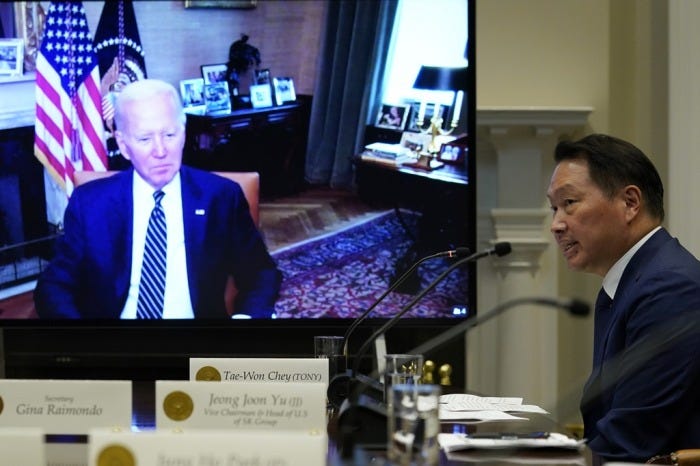
Chris Miller: Some might say that letting others subsidize certain projects is friend-shoring at its best — let our friends foot the bill for secure supply. But there’s another interpretation — isn’t that what we did in the 1990s, 2000s, and 2010s that got us into this position of high dependency on critical goods from a small number of regions? How do you distinguish between “good” friend-shoring and problematic dependency?
Dan Kim: It’s not really about subsidizing — it’s about leveraging natural competitive advantages. Economics is about trade-offs. We could onshore 100% of printed circuit board manufacturing, but is that the best use of the marginal dollar? Could you use that money for something else?
I take your point, Chris. The story of the semiconductor industry from the late 90s to today is that the biggest market force has been the fabless-foundry model. Before we criticize it, let’s recognize it’s been a huge force for good for American industry. It allowed Apple to create the most successful compute product in the history of mankind – the iPhone, Nvidia to create a new compute architecture, AMD to challenge Intel’s monopoly, and Qualcomm to invent the future of wireless tech from 2G onwards — now they’re doing 6G. If we required them to own fabs, invention would have been slower.
There are systematic risks built into offshoring, but we also have to look at the good things that happened as a result and make sure we don’t throw that baby out with the bathwater while addressing the risks systematically. We couldn’t have done the CHIPS Act without huge engagement with fabless customers. It wouldn’t have worked otherwise.
Who Wins the 21st Century?
Jordan Schneider: Dan, this brings us to the central question — who’s going to win the 21st century, the US or China? We can boil this down to a choice — would you rather be Apple, or Xiaomi plus BYD?
On one hand, you have Apple — worth trillions, defining paradigms, and making more money than God. On the other, we have Xiaomi and BYD. Together, they are worth a fraction of Apple, maybe $300 billion combined. Yet, at least on the BYD side, they’re global leaders in an industry where they can underprice American competition by at least 2x. Meanwhile, Xiaomi, though still dependent on TSMC for flagship phones, successfully pivoted into electric vehicles — a market Apple abandoned because it wasn’t profitable enough or was simply too much of a headache.
Using these case studies as an exercise in national power, national competitiveness, and economic security — that’s worth a few minutes. Curious for both of your takes.
Dan Kim: My first thought is — why can’t we have both? Why must we choose?
Apple’s path is harder because it is inventing the future and taking risks. While they don’t always get credit for it, they are the unquestioned leaders in smartphone technology. Xiaomi and BYD are fast followers. These are fast-following companies out of East Asia — not just China, but other countries too. It is inherently harder to take risks and invent something new. I wouldn’t want to abandon the Apple model given the massive spillover benefits to the American economy.
But at the same time, the question is — why can’t we have a Xiaomi-like company too? Can the American system reward both the inventors and new creators while also rewarding fast followers? Can the capital system do that?
Korea is instructive here — they used fast-following to catch up and now possess unquestionably the world’s best memory technology, which the world depends on.
Maybe that’s where China is headed next. Implicit in your question is — if China is cornering the fast-follower market and we have no competitor, maybe we should just have Xiaomi or take the Xiaomi pathway. But someone has to go first, someone has to invent this. Someone has to be the Nvidia, the Apple, the Qualcomm. I would rather those inventors be in the U.S. than anywhere else.
Chris Miller: I am sympathetic to the question, Jordan, but here’s the counterargument — Xiaomi has made as many phones as Apple but makes almost no money. Every year Apple captures 80% of the entire smartphone industry’s profits. As a business, you would much rather be Apple. Xiaomi did diversify into cars, but only after Tesla. That’s less obviously impressive.
BYD is more compelling because they revolutionized manufacturing to drive down costs in a way no one else can match. However, this happened while Elon Musk was distracted with other things and more importantly, Musk’s bet is on autonomy and robotics, not just selling cars. In ten years, a company that bet entirely on selling cars might look like it made a bad wager. I wouldn’t want to bet entirely on the business of selling X or Y if it’s going to be transformed. I worry that the Xiaomis and BYDs, being fast followers, are condemned to that fate. Although BYD does seem pretty impressive.
Dan Kim: At TechInsights, we perform teardowns to analyze components. Comparing the iPhone 17 Pro against the Xiaomi 17 is fascinating. Xiaomi skipped numbers to match Apple’s naming convention, and the phones look eerily similar. in terms of design and feel, but Xiaomi is ahead on some components — more battery capacity, fast charging. And they’re not using a Xiaomi-designed application processor.
What’s really interesting is that if you crack open China-made smartphones (excluding Huawei, which is entity-listed and must rely on Chinese supply chains and their own designs), you find surprisingly little Chinese technology, but there’s a lot of American, European, and Korean technology inside. Xiaomi is effectively a fast follower using globally available technologies. That’s a different business model than Apple. Both have huge influence in different ways, but I’m with Dan on this one.
Chris Miller: That is fine if you are maximizing profit. But if you are maximizing geopolitical influence, do you look for different variables? Is manufacturing output more correlated with geopolitical power than market capitalization?
Dan Kim: That is a difficult question. However, China’s smartphone strategy offers a clue. Clearly, their policy hasn’t been “substitute away from American technology immediately” — it has been “make globally competitive phones.”
Remember when China tried to make its own 3G standard? The American industry response was, “You can’t do that because then we can’t sell into the Chinese market. You have to go to a global standard.” China realized that they needed to compete globally. That was the path forward.
That pivot served them well. Today, unless you supply the Chinese smartphone market, you aren’t a truly competitive global supplier.
Jordan Schneider: The government wanted it, but the Chinese firms pushed back. That ended up being the dynamic.
Dan Kim: Right. And it’s actually served China quite well. If you look at the smartphone market now, unless you’re supplying to the Chinese smartphone market, you’re not really a competitive supplier into the smartphone supply market — or at least you’re very limited. From a Chinese perspective, it’s had numerous benefits.
This is really instructive for the AI world as well. How far do they want self-sufficiency? Semiconductor success relies on international partnerships. What is an Nvidia GPU? It’s American technology coupled with Korean and American HBM technology, made in Taiwan, packaged somewhere else, and sold globally. That is incredibly powerful. If China’s response is “we’re going to do everything ourselves,” that’s inherently a losing hand.
Wartime vs. Peacetime Economics
Jordan Schneider: Let’s ask the sharp version of Chris’s question — Apple and Google have a cute $4 trillion valuation. I wonder if World War III would get in the way of that?
If a dramatic conflict or even a sharp economic warfare escalation occurred (like if rare earths wasn’t “solved”) would the domestic manufacturing capacity — the fast-fashion manufacturing version of economic productivity emphasized by the Chinese model (BYD, Xiaomi, DJI) — give them an edge over America’s giant, rich, but globally dependent companies?
Dan Kim: You raise a couple of good points. Has America forgotten — or at least failed to exercise — its manufacturing muscle to scale up quickly? The answer is probably yes. We encountered a lot of that during the CHIPS implementation.
However, planning an economy for wartime versus peacetime looks very different. Planning for peacetime is inherently more prosperous because you aim for efficiency, which drives production and productivity. If you aim solely for resilience, you add costs, which means less overall prosperity.
But the larger point — if you’re just thinking about which economy is best in a wartime scenario of power competition, quite frankly, the CHIPS Act is not the answer.
With $39 billion, we couldn’t de-risk from China and Taiwan completely. When I first came in, folks from the national security world, the intelligence world, asked, “can we use this to de-risk from China and Taiwan?” I said, “With $39 billion, no. And if you gave me $3 trillion, maybe—but even if I could, why would you?”
I might look foolish five years from now if there’s a huge disruption and we wish we could have done that. But executing a wartime scenario in peacetime is really difficult, and the market would have fought back.
We could have said in the CHIPS Act that we want production targets across different technologies. We could have said that we want to be self-sufficient in leading-edge logic semiconductors — maybe not making everything in the United States, but if we consume 50% of leading-edge logic (which we now consume more of because of AI production), then we need 50% production targets.
We didn’t go there for several reasons. If you mention a production target, the thought immediately goes to self-sufficiency. That becomes an autarky question. We wanted resilience, not total self-sufficiency. Also, it would take a lot more. Building that much capacity all at once would have crashed the market – if the applicants themselves were willing to do it, and they were not.
You could think theoretically about which is better, Xiaomi or Apple. The benefit of Xiaomi and BYD is that they can scale up quickly and produce things more quickly. I get that. But we live in a different world than even five years ago. The question now is automatically asked — where does our stuff come from? Can we diversify right away at the beginning rather than trying to fix it at the end? There’s a middle ground where we optimize for some level of resiliency rather than going all the way to wartime scenario planning.
Jordan Schneider: The base case might not be World War III, but rather an economic Cold War or trade wrestling. Even in 2022, we started to have export controls, but Chinese export controls and the rare earths snapback were still just discussed in think tank papers, not yet a reality. If we assume five or ten more years of the U.S. and China trying to get one up on the other by cutting off supplies, how does that feed into the efficiency-versus-resiliency trade-off — where do you want to spend time, effort, and resources?
Chris Miller: I appreciate your optimism that the base case isn’t World War III, but there is a complicated dynamic around expectations.
If you assume the base case is peace and prepare accordingly, you make yourself unable to stand up to the other side if they are preparing for war. In a crisis, you can’t stand your ground because you have to fold early down the escalation ladder.
This brings us back to the Cold War logic — why do you need 10,000 nuclear missiles? Because the ability to go all the way up the ladder impacts your ability to stand firm during a crisis.
On one hand, I’m totally with Dan — you don’t want to pay a $3 trillion price tag today to insure against a probabilistic event. On the other hand, if you follow that logic to its conclusion, you end up unable to defend your interests at all. It’s tricky.

Dan Kim: These are good points and hard questions. I’m glad smart people are engaging with them. I’ll come back to the Four Cs and focus on the second one — capability.
We all understand capacity — can we scale up and build capacity quickly? That’s a challenge. TSMC Arizona was a rough go at first, though they are now executing well. The fact that they’re yielding the 4nm at competitive rates gave them confidence to execute more. The first ones through the wall are heroes because they took a risk on an atrophied American ecosystem. There’s only so much money the government can give; they have to cover the rest. Customers willing to say “let’s try it” and manufacturers willing to risk their company’s future on this — to me, they are underappreciated. We should all thank them for that.
But let’s focus on capability, which I define as “know-how.” Do you know how to manufacture that thing at whatever volume? If you don’t have fabs, you lose the know-how. Practically, does a fab in the United States know how to manufacture your specific product? Is your good qualified there? If not, the time to qualify a power management chip or GPU is a two-to-three-year proposition.
I remember at Qualcomm, one of the supply chain managers asked me when I was one of the economists there, “Is there slack capacity in the market?” The answer was no. But you can’t wait for slack capacity first. You have to understand if that fab can actually make your product. Even the best fabs can’t make every product. A yield rate for a mature-node Chinese fab might be better than TSMC for some products. They have different specialties.
If we define economic security as minimizing time to recovery after a disruption — whether World War 3, a hurricane, an earthquake, or a huge demand surge from a pandemic — how do you minimize the time to recovery to normal settings? If you have to do capability building — bring in the know-how within the fab, train the right people, get the recipes right — that’s a two-year process. And you have to build the fab first sequentially. That’s a long time to recover if you don’t already have that in the United States.
But if you have one fab, if you have some level of qualification at 7nm, 14nm, 28nm, then you’ve built in resiliency by shortening time to recovery for your supply chain as a company or country. We looked at that too.
That thinking didn’t require us to think about war — just about what’s more resilient. The challenge was that when the market aims for efficiency, it produces corner solutions where you qualify everything in one location. How do you solve for qualifying at multiple locations for the same node? We thought about whether we could pay companies as part of the CHIPS Act for design porting costs. Practical questions.
I would love for there to be more discussion of how to measure economic security. Can we define something like time to recovery as a metric, then dive deep into what it takes to recover, what the market can bear, and what the government needs to do in terms of supply and demand signals to solve for the optimal level? That discussion just doesn’t happen, even in forums like this. But we had to think about all of it at CHIPS.
When doing trade-offs, we thought — is it more worth having viable volume of, say, TSMC’s 28 nanometers in the United States than an additional 3-nanometer fab? Which one is more economically resilient? Some would argue the mature one, some the 3-nanometer. It’s a healthy debate, but at least you have a parameter to debate it. If you want to be really cold and calculated, you could put metrics on it — whichever has the highest number, you build first. Additional dollars go to the other one. Industrial policy doesn’t really work that way in the debating forum. But in practice, you had to do that whether people saw it or not.
Jordan Schneider: Some of it comes back to Chris’s point — you are only as strong as your weakest link. It’s nice to fix one thing, but it’s not just fixing the thing — it’s that thing multiplied by the GDP impact or employment impact of what that gap would deliver.
Dan Kim: That’s your strongest argument, Jordan, for “let’s have more Xiaomis and BYDs.” Xiaomis and BYDs aren’t the result of a super innovative founder who said, “We need a fast catch-up company on smartphones.” It’s an economic system that rewards fast following and scaling up quickly. If you compare two different systems and who would win in a war scenario, I can see where that argument goes. There’s more thinking needed about how to optimize for both peacetime prosperity while living in two-power competition.
Chris Miller: Exactly. It’s not just the wartime scenario; it’s the economic warfare scenario we are living in right now.
The calculus is complicated. First, if you lack a specific component (like a ten-cent microcontroller), you face downstream disruption (a stalled $10,000 car). Second, whose system can take more pain?
The experience in 2025 suggested that China is willing to take more economic pain than we are, which is why rare earth controls, an export control situation that was not costless at all for China in the short run or long run, proved effective nevertheless.
Dan Kim: What’s been fascinating, listening to your podcast with previous guests, Jordan, is this dual thought from Biden administration officials on export controls. I think Ben said if he had his way, he would have done more semicap equipment controls right away. But I’ve also heard Jake Sullivan or others say they were judicious about how far they pushed because they didn’t want instantaneous overreaction.
So which is it? These are smart people. Was there thinking behind, if we do this, we could escalate this way, so leave room for that, but exercise to 20% because that’s optimal? I hope they had all this thinking. But then you run up against — can we actually administer this with all the bureaucracy?
If national security resilience is defined as who has the largest escalation power, then you wouldn’t look for a complete supply chain— just for the most vulnerable one and dominate that. Maybe that’s the corner solution. But I don’t think that’s where you want to be as an economy either.
I would want diversity of supply chain resiliency and a system that rewards that. It’s fascinating that financial institutions are now looking into how to fund resiliency into the economy — like the JPMorgan Chase Resiliency Initiative. I’d love to see how that pans out. How would they define it? Where do they put their own money? What’s their willingness to not optimize for profitability for the sake of resiliency as a bank?
These are fascinating questions being played out in real time. I hope we find that our resiliency system, however it ends up, is more dynamic, more prosperous, and more secure than the alternative.
The Case for Managed Dependence
Jordan Schneider: Chris, can you talk through your offensive versus defensive mix in this? We were talking earlier about how dependent the Xiaomis of the world still are. And you just mentioned the financial system — that’s a whole other giant can of worms. If you’re a Chinese economic policymaker stressed about getting into an economic escalatory ladder with an American president, how do you tie the chips manufacturing industrial strategy piece with America developing and maintaining leverage over China?
Chris Miller: I don’t have my thoughts completely straight on this issue yet, but the best explanation I’ve heard is that intermediate goods are uniquely powerful as economic weapons relative to finished goods because the disruption they cause is so much larger. If you cut off the sale of a smartphone chip, you disrupt the smartphone industry. But cut off a microcontroller and you impact dishwashers and autos — it’s much broader. If you cut off the sale of photoresists and you’ve got a monopoly there, maybe you could shut down an entire country’s production base if your monopoly is strong enough.
There are different offensive versus defensive dynamics around different types of products. I’m not sure we’ve got a clear sense of how that generally falls, beyond a general view that the earlier you are in a supply chain, the more disruptive potential you probably have.
Dan Kim: There’s also inherently a higher cost if a supply chain is already set and not emerging for substitution. When the Japanese government placed an export control on photolithography materials on Korea because of some unrelated political issue, it was an odd moment for the industry. There’s nothing they can do to make historical grievances between Korea and Japan go away. What do you do?
What was interesting is, after Japan did that, they almost immediately moved to soften it — as if to say, “we can exercise this, but we’re not going to.” How does the industry react? It gives them a terrible choice — live with the risk, or encourage a domestic supplier that’s going to be inferior for the next few years. And if and when that does come online, do you then redo your supply chain and qualifications based on that inferior chemical? That’s also a terrible choice. Anytime you introduce a disruption in an established ecosystem, it’s just hard.
This is fascinating in the context of export controls and AI debates now. Jordan, maybe this is a time I could make a comment that I hope will not be mistaken for lobbying for Nvidia.
You’ve had many guests on, and you’ve said on your podcast that you would like someone from Nvidia or someone advocating for Nvidia to come on and make the case that they should sell H20s into China. You’ve had many guests argue very powerfully about the national security arguments on the other side — that you should not sell any there, that it’s all about the amount of compute.
If you’re taking a long view — and I’m not saying I’m advocating this necessarily — but I am concerned that the national security establishment in the United States and our national security champion — which, like it or not, is Nvidia — are speaking such different languages towards each other. That’s inherently risky.
One thing not being mentioned — what is the optimal amount of American-made AI chips in China? Is it zero or not zero? You can make the argument that it is not necessarily zero for the very reasons we’re talking about here. If you let that supply chain set into the AI ecosystem, it gives you leverage down the line to exercise that and take it away, making it costly for them.
I don’t think it translates directly from the photoresist example to an AI chip, but it’s a debate worth having. If you’re playing the long game, is the optimal level of American chip usage in China zero, or something else? That’s an interesting thought experiment. Escalation dominance includes some level of usage of that good by the other side already, some dependence on it. If you take that dependence away at the beginning of a supply chain being set, that changes things.
The other thing I would say is — if I were on the other side of this, which I’m not — if you consider your customers to not necessarily be chip purchasers but AI developers using your code base, is the optimal level of users from China zero or something else? If it’s not zero, then what’s the appropriate export control policy to get that optimal level?
You could still conclude it’s zero because maybe it’s all about AI compute power and you want the biggest lead. But I haven’t heard that discussion and debate in that framework. I hope at some point there will be.
Jordan Schneider: The generic retort would be — it’s not zero, because all these companies are using Nvidia chips in Malaysia. That’s the base case right now. There’s some splitting the difference here — they’re still training and developing and deploying models on these chips, still buying them. Alicloud and Nvidia are announcing partnerships in Brazil. These ecosystems aren’t entirely separate. I’m positing the Ben Buchanan retort here.
Dan Kim: That’s very fair, and I have enormous respect for your previous guests like Chris McGuire, Dmitri and others who have argued for pretty much zero and as much lead as possible. But it’s always worth considering the other side and thinking about the optimal outcome, especially if you believe this is going to be competition for the next couple of generations, that there will be shifts in technology we’ll be inherently better at making, and that you want escalation dominance. All that has to be considered.
I’m not an expert on export controls, but when you think about economic security, I also don’t think it’s optimal to produce 100% of leading-edge chips in the United States. Taiwan has served us really well. Korea has served us really well. The international relationships formed as part of that serve the world well. I would hate for us to lose that or have the impetus to lose that.
The Economic Security Problem No One Has Solved
Jordan Schneider: Earlier, Dan, you said you hope more people will take up some of the questions we’ve been exploring today. We’re launching an essay contest trying to broaden the field of folks considering what economic security means and how industrial strategy should be deployed. What do you think are the first questions we should pose to the world — questions that can be fruitfully tackled in 3,000 words or less?
Chris Miller: First, the question of escalation management — how do you know which side is more capable or willing to sustain the cost of escalation — is key. There have been miscalculations around that in a big way the last 12 months on our side. That’s wide open.
Also, learning lessons from the Cold War and beyond about deterrence and how to produce it. It’s a wide open space. We clearly don’t have deterrence right now. Neither the Chinese nor we have deterrence, which makes things particularly unstable. But I also don’t know what conditions would actually enable deterrence in the economic security space. That seems ripe for interesting thinking.
Dan Kim: It would be great if we could introduce thinkers in economics to these questions about what resiliency means, how it should be defined, and what metrics should be used. There aren’t enough discussions between economists, international relations thinkers, and national security professionals.
One of the magic things about CHIPS was that all of those kinds of professionals were mixed into one pot to come up with a strategy. It was fun to talk to people from national security agencies, intelligence agencies, investment bankers, people that worked in childcare — for us all to think about what this means together and present our findings to leadership.
I’d like to see more rigorous definitions around economic security — metrics and optimization, which economists are really good at — and better frameworks for policymakers who come in saying, “this is the framework we’re following.” It doesn’t have to be one framework, but rigorous debates around it would be helpful.
Institutional design around economic security and execution is worth thinking about. The CHIPS Act had two components to its execution. One was at the Treasury Department — a non-competitive tax credit, meaning if you build it, you don’t have to compete with other companies. There wasn’t a finite number of tax credits to fight for — it was unlimited if you built it. Very helpful. The second component — Congress delegated authority to the Commerce Department and the Commerce Secretary to execute the grant program and establish R&D.
I noticed in the economic security statements and work from CFR, one recommendation was for there to be an economic security office in the Commerce Department. I would love to think about how that would look in practice.
But I’d also want an essay comparing the strengths and weaknesses of different types of institutional execution. For example, what would an independent agency, like a Federal Reserve for industrial policy, look like? What kind of mandate would Congress delegate? What would their metrics be? What tools would you give them?
This is relevant because industry is contending with very different approaches to industrial policy execution depending on who’s in the White House. Congress did delegate authority to the Commerce Secretary, who inherently answers to the President. They took that risk. For Congress, is that a risk you want to continue taking for the sake of keeping it within that process, or do you want less fluctuation with political changes and more predictability?
One of the strengths of East Asian industrial policy isn’t necessarily how much they subsidize — that’s always a misconception. There’s this belief that the Taiwanese and Korean governments are subsidizing fabs quite a bit. They don’t actually. What they do is create a very stable business environment for critical sectors to manufacture — fewer permits, more predictable requirements. One thing we learned with CHIPS was that we don’t have that here yet. More work is needed to establish it.
One practical thing we ran into — once you make a deal (there was and still is so much focus on making deals because there’s money left), how do you follow up? These are five- to ten-year projects. There was a portfolio manager whose purpose was to ensure conditions were being met, or to adjust conditions if they needed to change. What if technology shifts and we want them to produce something else? How do you do that within the CHIPS team concept? Do you want that still in the Commerce Department or somewhere else?
There are strengths and weaknesses to all approaches. It’s not a good outcome to just do a tax credit. It’s not a good idea to just do grants. Some thinking around how to institutionalize this, now that we’ve had our first lessons with CHIPS, would be really interesting.
Another question — how much coordination do you want between protect and promote? In practice, the export controls and promotion of building fabs — there was really no formal mechanism for good communication between these agencies and communities. I had good conversations with Alan Estevez’s team. But oftentimes we looked at each other and said, “We should work with each other more formally, but we don’t,” unless there was a very specific interagency ask. That was rare.
We had to define what we thought critical technologies were that we wanted to prioritize at CHIPS and invest in. You could easily think, what critical technologies do we then need to control? But we didn’t think about it that way until we had discussions with folks at BIS and Defense and others. Is it worth creating a watchtower where everything related to industrial policy is being considered, and you give them the toolsets — both demand side, supply side, and export control side — to execute the vision, rather than doing everything piecemeal?
I had a conversation with the Commerce Secretary and told her — you realize you’re the closest thing we have to a semiconductor czar. You’re the only one that really sees what we’re doing in terms of control as well as investments. It’s really up to you how much you want us to coordinate. Maybe it should be someone’s responsibility to oversee everything there. The White House did a lot of that, but they had many different things pulling them in different directions. In a world where it’s not just semiconductors but all critical sectors and capabilities, does it make sense to create some institution to execute all of that? That’s an interesting question for your essay contest.
Jordan Schneider: Particularly as we’re living in a world where the Department of Defense is increasingly getting these huge loan authorities and striking purchase floor agreements — that Commerce-Defense conversation, as well as all these export agencies which we haven’t really talked about. There are a lot of different pieces and tools on the table, and there is not one craftsman. There’s no central METI organization in charge of dialing all these things in, for better or for worse.
What Would You Do With $10 Million?
Last one for you, Dan. Say you have $5 million to spend to build a little team or commission some more ambitious things than what a ChinaTalk essay contest can deliver. How are you spending that money?
Dan Kim: $5 million?
Jordan Schneider: Okay, $10 million.
Dan Kim: I’m going to exclude myself here. The CHIPS team — the one that’s there now and the one that was there before — is one of the best groups of people I’ve ever met. A national treasure as a team, for what they were able to do and what they continue to do. If I had $10 million, I would find a way to pay all of them more money so they could stay longer and continue to execute. Institutional muscle is very important for the country.
Some people came from having made their money and joined government to serve — maybe they don’t need the pay bump. But there were a lot of up-and-coming early-career folks who could have gone elsewhere but decided to join. I would have loved to find a way to compensate them at a higher market value so they could stay longer. That’s where I would spend $10 million. If you said $10 billion, that’s a different question.
We’re in an interesting time, Jordan. We do lots of technical analysis here at TechInsights and have pretty much the best market intelligence in the industry. What’s striking is that the US and China are both so dependent on foreign sources for their AI hardware and critical technologies. Neither is anywhere close to being self-sufficient. I suspect that’ll be the case for many years.
Industrial policy, as much as we talked about insourcing and domestic production, is also about international relations — recognizing the dependence and, as we said, maybe there’s a right level of dependence.
I have to give a lot of credit to companies like TSMC, Samsung, and SK Hynix for choosing to invest and partner with the United States in whatever political environment they find themselves in, willing to look past the faults and choosing to believe in the best of America. That’s partly because of White House pressure, partly because of customers sending the right signals. But at heart, when I talk to these executives, they fundamentally believe in the United States and what it stands for. We should never forget that.
I told you earlier that if I could choose, my outro song would be Kendrick Lamar’s m.A.A.d city. There is a line at the beginning where Kendrick takes us down memory lane to his rough childhood neighborhood. Some violence happened in his neighborhood, and someone is talking to him and says, “Man down.” And he says to Kendrick, “Where are you from?” — questioning where he’s from. He says: “F*** who you know, where are you from?” And to reiterate the point: “Where your grandma stay?”
I thought of that song when I was looking at the images of Korean workers in Georgia being shackled and being deported. I understand the argument about being law-abiding and everything else, but when you look at the news coverage in Korea, one commentator said something that’s seared into my brain — “It seems the United States wants our money and our technology, but they don’t want us.”

In a world where both the US and China are dependent on technologies from other sources, and industrial policy is as much about international relations as domestic production, it really matters what kind of environment we create for companies and workers here to feel welcome and be part of the United States. I hope that’s part of the goal of industrial policy. Because at the end of the day, we’re not just talking about technologies or countries — we’re talking about people.
When I was working at SK, being sent to the United States as an expat was a coveted thing. It meant they could send their families, educate their children in the United States, and perhaps go to American colleges. It’s something a lot of executives and the best talent wanted to do. I would hope we could continue to have that as a soft power draw — an integral part of industrial policy, no matter where you fall on the political spectrum or how hawkish you are against China. It’s the integral part that underlies the basis for both our hard power and our soft power as a country.
Thank you for discussing these topics , Ive been trying to come up with a framework or mental model for how to think about the trade off between industrial resilience and peace time economics and it feels like this is the first thing that’s digging into this
«However, memory production operates very differently from customized ASIC chips or GPUs from a leading-edge foundry. Memory chips are a standardized good with an oligopoly (there are three DRAM producers) that are roughly substitutable. [...] That is not how it functions at a customized leading-edge foundry.»
Actually that is how things used to work for leading-edge chips too; since decades ago for example both Intel and AMD produce the same type of high-end CPU chips because Intel's customers (in particular the military) insisted on having a second fully independent source and forced Intel to license AMD their high-end CPU architecture.
But business schools teach vendors to differentiate and build monopolistic moats and teach buyers that what matters is only the lower price in the short term rather than having multiple sources; so while high-end CPU chips are still mostly software-compatible between AMD and Intel in particular Intel which had a dominant position tried very hard to reduce compatibility and become single-source and as part of that they introduced a new single-source high-end CPU design called "Itanium" (which fortunately flopped).
«Samsung, TSMC, and Intel are not saying, “Here’s a standard. Apple, come to us with a standard and we’ll all figure out how to make it, and then you can substitute among all three of us.” That’s not how it works.»
Actually that is exactly what they did for mid-range CPUs based on the "ARM" standard architecture. Then Apple took the "ARM" standard and worked hard to differentiate it.
«Practically, what does it mean to have dual supply for an AMD or Nvidia? The most sense is to have one chip fabricated at one foundry, another model at another foundry»
When Intel was dominant they built many foundries by *exactly* replicating a model foundry into several others. That provided more capacity (with which they hoped to destroy AMD as an independent source) but not much extra resilience.
«When I was at SK Hynix, I found it fascinating that the CEO didn’t want to exceed a certain market share for customers like Dell for average server DRAM. They wanted customers to have supply resilience through other suppliers, which is very counterintuitive. That’s how they wanted to do business – they preferred long-term contracts. This works because it’s a standardized good with standards set at JEDEC.»
It works for a very different reason: they are prepared to accept (at least initially) a lower ROI on capital in exchange for long-term survival. That is pretty much much the secret of the "Asian Miracle" so far.