
In 2025, ChinaTalk’s eighth year of existence and my third doing it full time, we did the thing. We put out on the newsletter over 150 editions that centered on China AI lab, policy, and application coverage.
On the podcast we published a hundred shows about:
Chinese elite politics and US-China policy
US-China chips and AI
Economic statecraft around export controls and tariffs, which made up the majority of our ten emergency pods this year (double 2024’s emergencies!)
A growing focus on defense, with the launch of our weekly Second Breakfast show, a good bit of military history and our AI and the Future of War series
ChinaTalk’s substack grew 60% this year to 65k subscribers. This is a really big number. The second largest think tank substack is SCSP, which has 35k. Recent CFR, the Atlantic Council, and Brookings annual reports say that, after two decades of building lists, they each have around 200k total email subscribers. Not a bad showing for ChinaTalk’s much smaller budget only three years in the game.
The show gets 10-15k listens per show across the podcast and YouTube, and was downloaded a million times last year. These are also really big numbers. Across all of foreign policy think tank-dom, only one show (CFR’s The President’s Inbox) is bigger. And it’s not like Mass Ave isn’t trying. CSIS has 40 shows alone.
Why do so many people engage with our work?
US-China tech is an covering important, underserved niche. A year after DeepSeek, to my endless surprise there are still only a handful of analysts working in English in public on tech and China. While there is more out there on the defense side, most coverage tends toward SpecOps bro, Zeihan geopolitics bro, or lifeless industry coverage.
We make substantive, engaging content that resonates in today’s media landscape. In traditional think tanks, podcasts, newsletters and responses to news developments are afterthoughts to the long reports and small in-person events funders expect as outputs. Since podcasts and research with outputs under 10,000 words often aren’t directly funded and so happen on fellows’ personal time, talent in these areas isn’t hired for or developed. By only accepting unrestricted funding, we’ve had to limit our headcount growth, but it ensures we’re covering what matters today, not getting stuck writing long reports that won’t matter by the time they’re finished in the extremely fast-moving field of US-China and technology.
Brands matter in DC way less than they used to. Writing a smart newsletter in some ways even gains you credibility vs working at a brand name think tank, university, or news organization. It blew my mind as well to learn that Jasmine Sun wrote that “I was shocked to learn from a senior WaPo reporter that they consider anything over 10,000 views good.” Our worst performing posts do more than this!
2025 was the year to test whether I wanted to grow a research team or continue to float along as an extended Ezra Klein cosplay, podcasting and writing when the mood strikes. The answer to that is a definitive yes to growing a team. It's been a pleasure getting to empower young talent in an open ended, self-driven think tank position I wish existed when I was in my 20s. We’ve brought on some great analysts who have all already contributed to the national conversation: Lily Ottinger, Irene Zhang, Nick Corvino, and Aqib Zakaria.
Unfortunately, funding is still holding us back from the fully humming ChinaTalk as we don’t have the money to grow headcount. If you’re interested in seeing ChinaTalk flourish even more in 2026, please get in touch!
What follows is a rundown of our most memorable podcasts and articles.
Our 10 Most Memorable Podcast Episodes of the Year
Here’s a spotify playlist to listen to them!
Contemporary Politics
PLA Purges with Jon Czin
Jon Czin, longtime CIA China analyst now in the think tank world, chatted PLA purges. I’ve done less domestic chinese political coverage of late, as not much surprising or dramatic has happened since the COVID response drama, but the PLA purges are easily the most interesting domestic elite political development in years.
I’m also pretty proud of my thumbnail for this one…
Jake Sullivan
Felt like I’ve been prepping for this one for five years. All the other podcasts he’s done since leaving government followed the same trajectory of the hosts beating up on him for Gaza/Ukraine leading Sullivan to spend his airtime defending his record. I wanted to do something different, instead trying to explore what the experience is like of serving as NSA. I think we succeeded.
Dan Wang
Dan Wang came over to my house to discuss Breakneck, exploring China’s “engineering state” versus America’s “lawyerly society” through the lens of brutal social engineering projects. Wang argues China’s engineering mindset — treating society “as liquid flows” where “all human activity can be directed with the same ease as turning valves” — enabled four decades of 8-9% growth lifting hundreds of millions from poverty but also created “novel forms of political repression humanity has never seen.” We also did a podcaster all-star show with Dan Wang + Ezra + Derek!
Allied Scale and Net Assessment with Rush Doshi
If America doesn’t use its allies, it will lose the 21st century. This interview with Rush Doshi explores how the U.S. should strategically compete with China by leveraging partnerships with allies. While China faces real challenges like demographics and debt, Doshi argues that China’s scale, manufacturing dominance, and industrial capacity pose enduring strategic threats. He critiques both the Biden and Trump approaches to alliances: Biden’s overemphasis on persuasion and Trump’s heavy-handed use of coercion. Instead, Doshi emphasizes the need for capacity-centric statecraft, where allies help each other build economic, technological, and military strength.
China’s Rare Earth Controls
An emergency pod with the Two Chrises (Chris Miller and Chris McGuire) after China dropped their rare earth controls for the second time this fall. China successfully backing down the Trump administration by deploying rare earth controls felt like a turning point in the relationship.
Deepseek: What it Means and What Happens Next
Early in the year, Kevin Xu and I reflected on the long term implications of the DeepSeek saga, looking into what the firm does and doesn’t illustrate about Chinese innovation and implications for future US policy. It holds up pretty well!
Liberation Day Pod: MAGA: A Guide for the Perplexed with Tanner Greer
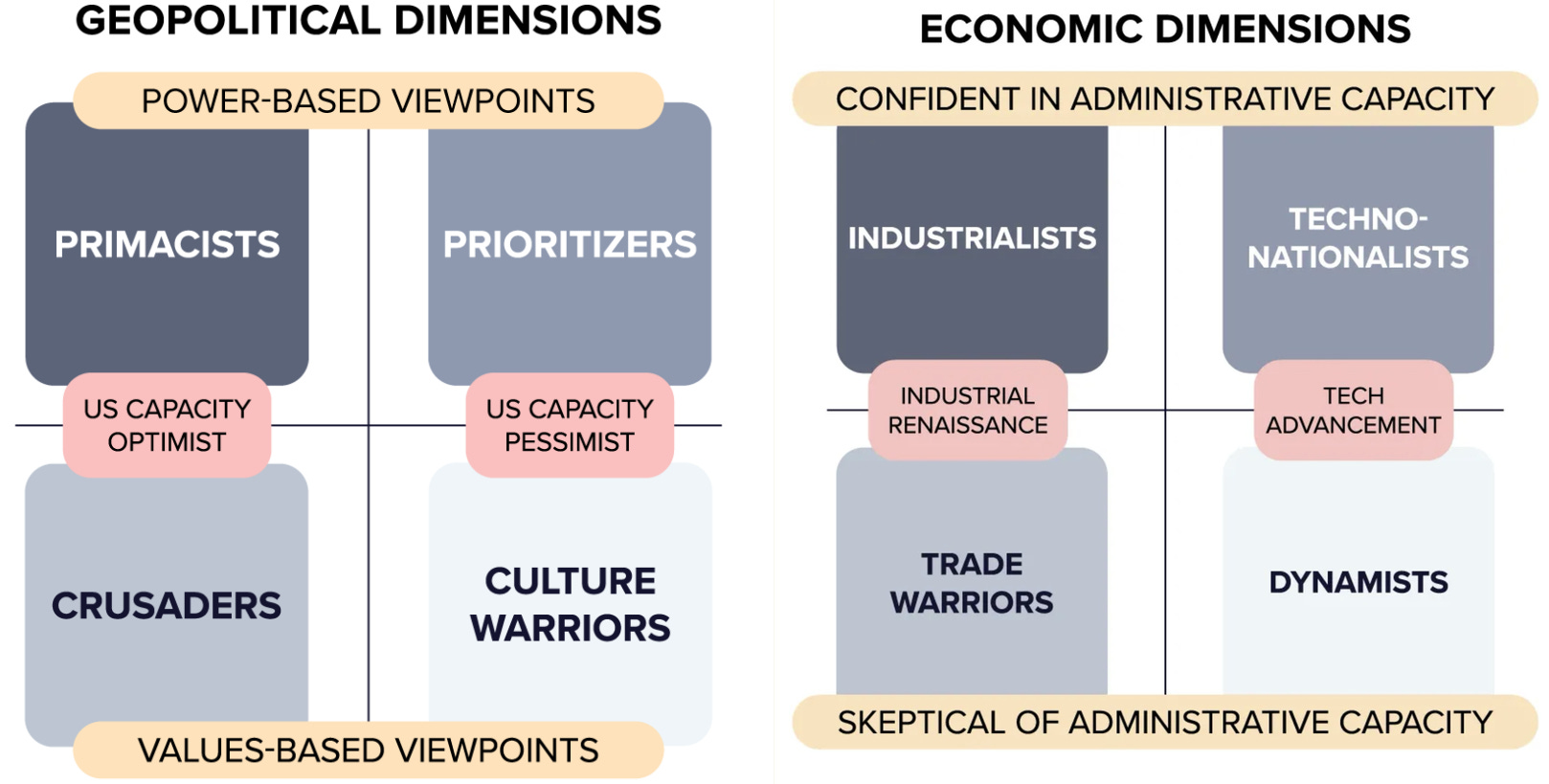
In this podcast episode, recorded on Liberation Day, Tanner Greer and I talk through the chaotic dynamics of Trump’s second administration China policy. Greer explains Trump’s unpredictable decision-making style, his use of internal factional conflict as a management tool, and the administration’s disjointed tariff policies. The conversation explores four quadrants of Trump World ideology and how adherents of each quadrant approach trade, industrial policy, and Taiwan.
Trump’s Pivot to Putin + AGI and the Future of Warfare
Recorded the day after Trump’s disastrous meeting with Zelensky in the Oval Office, Mike Horowitz, Shashank and I discussed what the brave new world of Trump’s global diplomacy and just how much war is changing. The second Shashank show of the yar we did following up with Rob Lee exploring to what extent the war in Ukraine is a revolution in military affairs continues the theme.
History
Inside the Soviet Cold War Machine
Sergey Radchenko’s To Run the World explores the Cold War not as a clash of ideologies, but as a tragic and often absurd contest for prestige, legitimacy, and recognition among insecure leaders struggling to validate their power, both externally and at home. In this interview, Radchenko argues that authoritarian regimes, especially the USSR and China, pursued global influence to compensate for internal weakness.
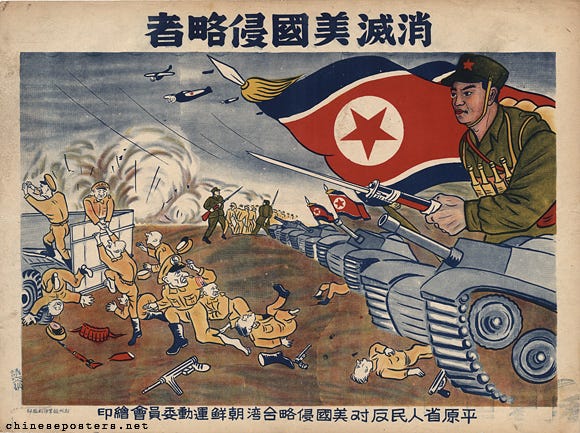
Part two came out in April, and it’s even better than part one! In this deep-dive, Radchenko unravels how personal egos and the battle for international prestige shaped Soviet decision-making — from Khrushchev’s downfall to Brezhnev’s Vietnam gamble, the paranoid Sino-Soviet split, Nixon’s unlikely détente, and the disastrous invasion of Afghanistan. This episode asks the question, what if boredom, not grand strategy, is what starts wars?
The Party’s Interests Comes First
Joseph Torigian’s biography of Xi Zhongxun reveals the CCP as simultaneously a religious organization and mafia — where suffering paradoxically deepens loyalty and persecution is a badge of honor. Our epic two-part interview explores the life of Xi Zhongxun, father of Xi Jinping, from his life as a young revolutionary to his purge and eventual rehabilitation.
The Long Shadow of Soviet Dissent: Disobedience from Moscow to Beijing
This ChinaTalk episode with historian Ben Nathans and longtime reporter Ian Johnson explores how Soviet dissidents built a moral and intellectual movement by demanding that the USSR live up to its own laws — a strategy pioneered by mathematician Alexander Volpin that later echoed in China’s rights-defense (维权) activism. Through episodes like the 1966 Sinyavsky-Daniel trial, dissidents transformed “socialist legality” and show trials into moral theater, using underground samizdat networks to expose the state’s hypocrisy and preserve truth.
The Pacific War
We explore Ian Toll’s incredibly expressive Pacific War trilogy, examining both his innovative narrative techniques and strategic questions about WWII’s Pacific theater. The conversation covers whether Allied victory was predetermined after Pearl Harbor, how Japan’s domestic political instability drove its military aggression abroad, the evolution of kamikaze tactics as a resource-scarcity solution, and the crucial role of media management in shaping military leaders like MacArthur and Halsey into national heroes. Part 1 and Part 2 here.
Most Memorable Articles of the Year
We already recapped our tech coverage in our “China AI in 2025 Wrapped” post, but I wanted to highlight a few more pieces that stood out.
On the travel side, Lily found some fascinating China connections travelling in Kyrgyzstan, Irene and Lily reflected on some Korean makeup and massacres, and I spent some time in Tel Aviv and the Bay Area.
On the war beat, we ran a piece by a Japanese colonel studying at Air War College in Alabama about lessons from how Japan intended to defend Taiwan against an American invasion in WWII.
I also updated my early career guide for folks who are interested in topics adjacent to ChinaTalk themes.
25 Biggest Events in US-China Relations This Century
Stealing Nate Silver’s listicle format, I ranked the 25 most important events in US-China relations this century. If there’s interest I could explain my reasoning in a full piece. I’d also be interested in taking submissions on this theme!
Xi Jinping becomes CCP General Secretary (18th Congress/1st plenum) — 11/15/2012
China joins the WTO (trade-driven takeoff shorthand) — 12/11/2001
Trump elected U.S. president — 11/08/2016
China abolishes PRC presidential term limits — 03/11/2018
Chen Shui-bian wins Taiwan presidential election — 03/18/2000
Shinzo Abe returns as Japan’s PM (Second Abe Cabinet inaugurated) — 12/26/2012
U.S. “Oct 7” export controls on advanced computing/semiconductor tools to China issued — 10/07/2022
“Liberation Day” tariffs announced (Rose Garden speech) — 04/02/2025
9/11 attacks — 09/11/2001
Dr. Li Wenliang dies as COVID escalates — 02/07/2020
“Made in China 2025” issued by State Council — 05/19/2015
Huawei added to the U.S. Entity List — 05/16/2019
Tsai Ing-wen wins Taiwan presidential election — 01/16/2016
Trump signs Section 301 action memo (trade war kickoff marker) — 03/22/2018
Lehman Brothers files for bankruptcy (financial crisis kickoff) — 09/15/2008
Hong Kong National Security Law takes effect — 06/30/2020
NYT publishes the “Xinjiang Papers” leak (standing in for Xinjiang repression) — 11/16/2019
DeepSeek releases R1 — 01/20/2025
Bo Xilai sentenced to life imprisonment — 09/22/2013
U.S. SecDef calls for halt to land reclamation/island-building (Shangri-La Dialogue) — 05/30/2015
Tibetan unrest begins with Lhasa protests — 03/10/2008
Beijing 2008 Olympics opening ceremony — 08/08/2008
U.S. BIS issues denial order cutting off ZTE’s export privileges — 04/15/2018
U.S.–China Anchorage talks open (Blinken/Sullivan vs. Yang/Wang) — 03/18/2021
Obama delivers “pivot to Asia” speech (Australia Parliament) — 11/17/2011
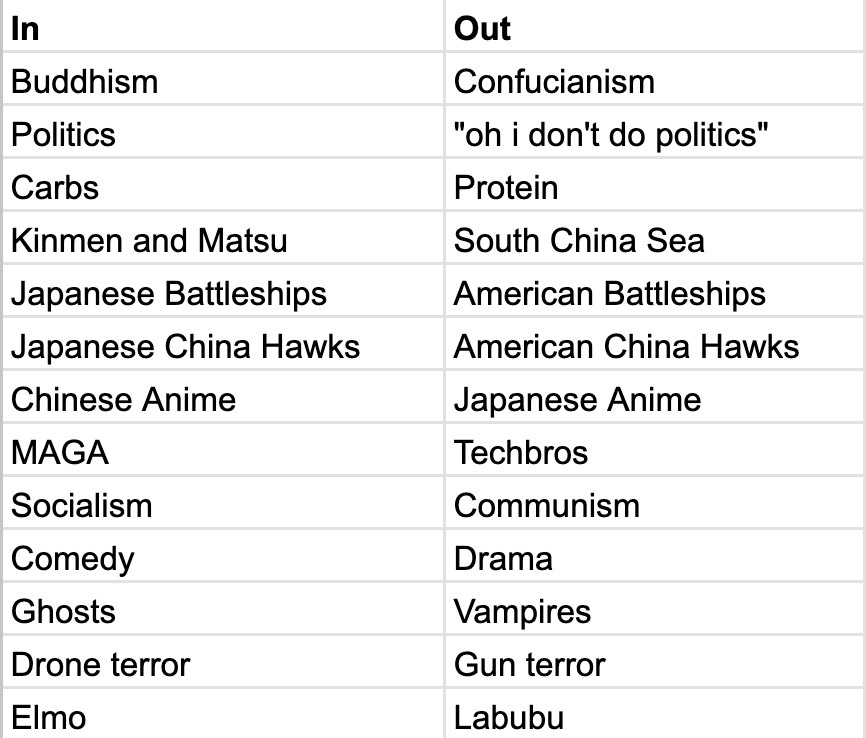
Ins and Outs for 2026
And lastly, borrowing the format from Jasmine Sun, we’re doing some Ins and Outs for 2026. Predictions are NOT endorsements!
Curious to know Jordan, who or how would you describe your target reader? the one that you feel most accountable to write for? (can't be yourself). What are their priors? what do think they get the most when reading your content?
Jordan, it's an opportunity to thank you for all the great coverage and content that you and the team does. It's certainly one of a kind and you're an inspiration, at least to me. ChinaTalk is where I want to be when i grow up as a substacker.
Youe coverage really helps me shape my thinking on China, US and the world we live in.
Looking forward to reading more and hopefully upgrading!